FaceShastra » Face Reading Guide » Face Reading for Intelligence
Face Reading for Intelligence — the Buddhi Seat
Intelligence in Sāmudrika Lakṣaṇa is the Buddhi seat — mind and learning — read at three places: the height of the forehead, the tail of the eyebrow and the set of the eyes. The tradition reads kinds of learning, not amounts of it: how a person takes knowledge in, whether they stay with a thing to mastery, and whether their judgement holds under pressure. This page reads the seat in full, with the passages, three worked faces, and the limits of the claim.
What the Buddhi seat is
Buddhi is the discriminating faculty — the part of the mind that judges — and Vidyā is learning. The Bṛhat Saṃhitā's readers were asked by parents which son would take to study, and by teachers which pupil would stay the course, and the seat they answered from is the upper face: the forehead, the brows and the eyes. Three readings, and a pointed refusal to add them up — the texts say a high forehead and a descending brow tail describe a quick learner who does not finish, not a person of 'medium intelligence'.
The forehead — how knowledge comes in
The height of the forehead, from brow to hairline, is read for the manner of learning. A high forehead marks strong memory and quick learning, noticed early in life — the child the teacher singles out. A moderate forehead is read, with evident respect, as practical knowledge and sound judgement over book learning; the commentators attach it to the administrator rather than the scholar. A lower forehead is the cautionary mark, and its reading is one of the kindest in the corpus: this person learns by doing, and what they learn stays with them.
It is a reading of channel, not of capacity. The tradition never says the low forehead knows less; it says the low forehead learns with the hands and forgets nothing it learned that way.
The brow tail — staying to mastery
The tail of the eyebrow — whether it rises or descends toward the temple — is read for persistence. A rising tail marks the person who keeps working long after others stop enjoying it; the readers considered this the rarer and more valuable sign in the seat, because talent without it produces beginnings. A descending tail is the mark of the fast starter who loses interest before mastery, and the text's remedy is structural: such a person should choose work with visible early results, or bind themselves to a teacher who will not let them stop.
The set of the eyes — judgement under pressure
The third reading is the set of the eye in the face — lifted and steady, or set low. A steady, lifted eye marks judgement that does not bend under pressure: the person who is right in the room, not only afterwards. An eye set low is read as judgement that is correct but often a little late — the person who knows the right answer on the way home. The reading does not doubt the judgement; it doubts its timing, and it is the one reading in the seat that an employer would pay for.
Three faces, read end to end
A high forehead, a rising brow tail, a steady lifted eye: the scholar's face as the tradition drew it — quick to learn, slow to stop, right on time. The readers reserved their word for a mind without a cautionary mark in the Buddhi seat, and it was not 'clever'; it was 'fit for the hardest study'.
A lower forehead, a rising tail, a lifted eye: learns by doing, never stops, judges well under pressure. This is the master craftsman's face, and the Saṃhitā ranks it beside the scholar's, not below — the persistence and the judgement are the same; only the channel differs.
A high forehead, a descending tail, an eye set low: fast learner, fast loser of interest, correct a moment late. The most common 'gifted child' reading, and the most useful, because every line of it is advice: choose work with early results, find a teacher who will not let go, and learn to say the right answer before leaving the room.

What the seat does not claim
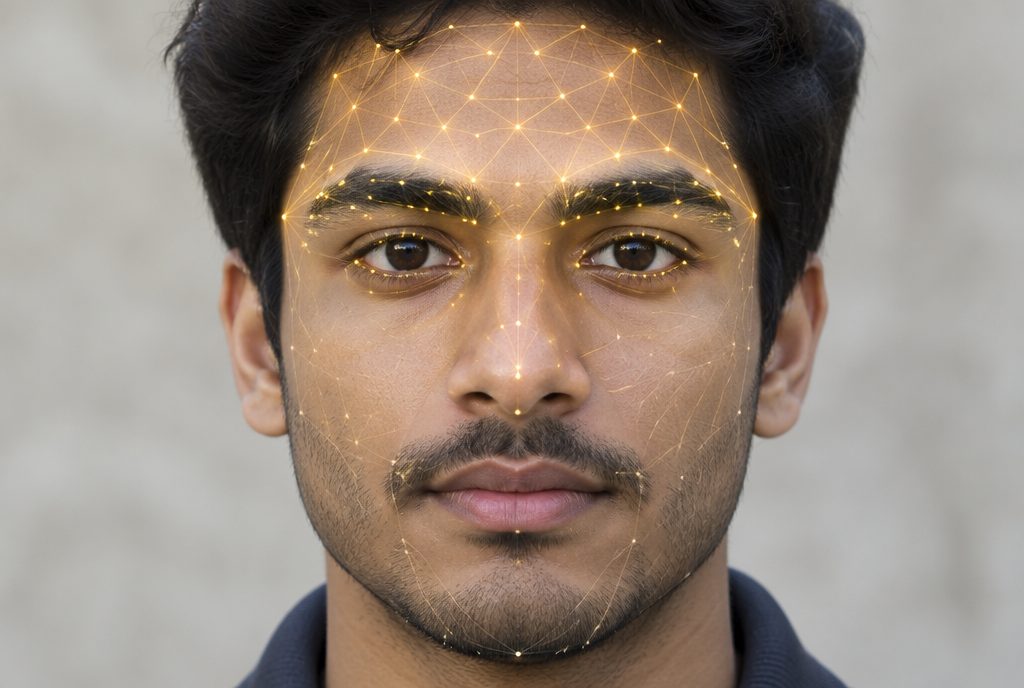
The Buddhi seat does not measure intelligence, does not score it, and does not compare one person with another. It reads three tendencies — how learning comes in, whether it is carried to mastery, and how judgement holds — as a 6th-century text described them. FaceShastra measures the three features at 478 landmark points and reports those passages, chapter cited, as cultural and educational content; nothing here is an assessment of any person's ability.
Feature by feature — where each reading sits
What does a high or low forehead mean?
A high forehead — strong memory and quick learning, noticed early in life. Full readings of this feature →
What does the tail of the eyebrow reveal?
Your brow tail rises — you keep working long after others stop enjoying it. Full readings of this feature →
What does the set of the eyes mean?
A steady, lifted eye — your judgement does not bend under pressure. Full readings of this feature →
Common questions
Does a high forehead mean high intelligence?
The texts read a high forehead as strong memory and quick learning, noticed early. It is a reading of how knowledge comes in, not how much; a lower forehead is read as learning by doing, which the tradition values equally.
Which facial feature shows persistence?
The tail of the eyebrow. A rising tail is read as the person who keeps working after others stop enjoying it; a descending tail as the fast starter who loses interest before mastery.
Can face reading measure IQ?
No. The Buddhi seat describes three tendencies — the channel of learning, persistence and judgement under pressure — as a classical text described them. It scores nothing and compares no one.
Read your own face — free.
Upload a photo; the reading runs in your browser and the photograph never leaves your device. Free summary, no signup to see it.
Get my free reading- Face Reading for Wealth — the Dhana Seat
- Face Reading for Marriage — the Kalatra Seat
- Face Reading for Career — the Karma Seat
- Face Reading for Health — the Ārogya Seat
- Face Reading for Love — the Kāma Seat
- Nose Reading — What the Nāsikā Tells About Wealth and Health
- Forehead Reading — Learning, Career and the Temples
- Eyebrow Reading — Attention, Will and Patience
- Eye Reading — Judgement, Attachment and the Marriage Seat