FaceShastra » Face Reading Guide » Face Reading for Career
Face Reading for Career — the Karma Seat
Career in Sāmudrika Lakṣaṇa is the Karma seat — work, vocation and authority — and it is read at four places: the plane of the forehead, the brow ridge, the frame of the face and the jaw. Each answers a different question: how authority comes, how standards show, what kind of work the face is built for, and whether what is started gets finished. This page reads the whole seat, with the passages, three worked faces, and the limits of the claim.
What the Karma seat is
Karma here means work — the Sanskrit sense of action and vocation, not the later sense of fate. The Bṛhat Saṃhitā's readers were asked, by parents and by kings, what a person was for: whether he would command, whether he would build, whether he would finish. The seat that answers is read at the top and the edges of the face — the forehead's plane, the brow ridge, the outline of the frame and the jaw — the features that move least and that the old readers treated as the face's architecture.
The four readings are ordered from how the world receives a person to how the person receives the world. The forehead reads how authority arrives. The brow ridge reads how standards are seen by others. The frame reads what kind of work suits. The jaw reads completion.
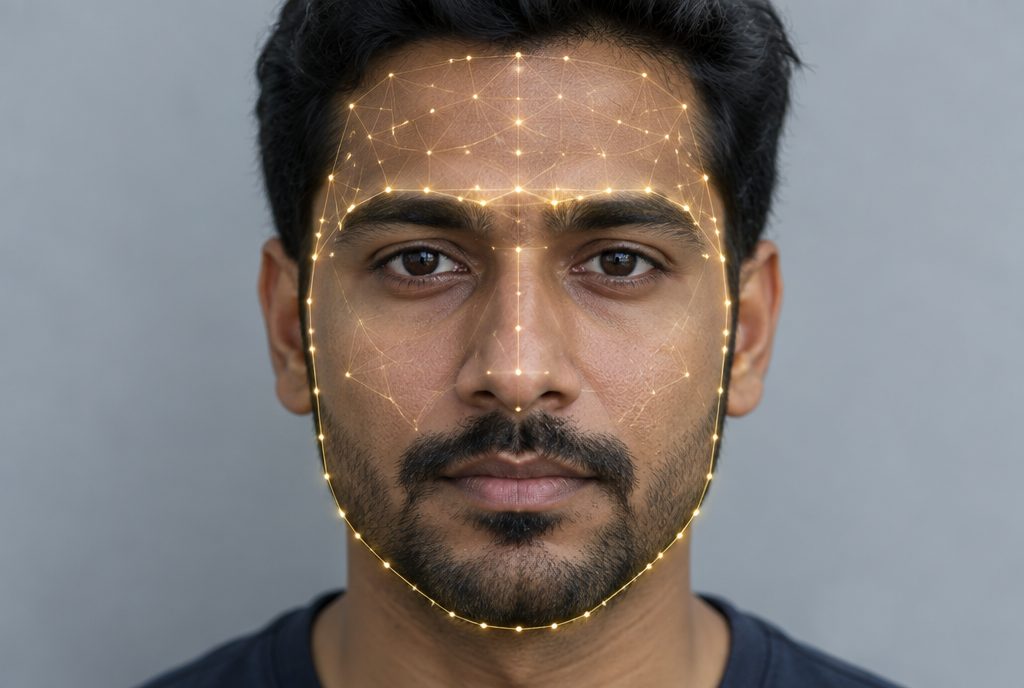
The forehead's plane — how authority arrives
The middle of the forehead, read for its breadth, is the tradition's authority reading. A broad mid-forehead marks authority handed to a person before they seek it — the one the room turns to. A moderate plane marks a person respected where their work is known, and the commentators' gloss is honest: respected there, and not much beyond. A compressed plane is the cautionary mark, and its reading is one of the fairest in the corpus — authority earned the tiring way, and kept. The Saṃhitā does not rank these; it describes three different careers.
The brow ridge — how standards show
The bony ridge above the eyes is read for the visibility of a person's standards. A defined ridge means the standards are visible — people know where this person stands before they ask, and the text adds that disagreement with such a person costs. A flat ridge marks the person underestimated in the first year and correctly valued by the third; the readers thought this a slow gift rather than a fault. A heavy ridge is force of will, and the reading's subtlety is that it reads differently above and below: to superiors it is stubbornness, to those who report to such a person it is protection.
The frame and the jaw — what work suits, and whether it gets finished
The outline of the face is read for the kind of work it is built for. A balanced frame is adaptable to many kinds — and the text names the cost: choosing is this person's challenge. A broad frame is built for scale and institutions; standing accrues to it and stays. A long frame is built for depth and specialisation, with the warning to beware its narrowness. A narrow frame is the one where the environment decides the output, and the advice is the most practical line in the seat: choose the room first.
The jaw reads completion. A set jaw finishes what it starts — including, the text notes drily, what it should abandon. A moderate jaw finishes reliably when someone is waiting for the result. A lighter jaw begins more than it ends, and the reading's remedy is precise: bind yourself to people, not to plans.
Three faces, read end to end
A broad mid-forehead, a defined ridge, a broad frame and a set jaw: the face the tradition reads as built to run something large. Authority comes early, standards are visible, institutions suit, and things get finished. The only warning in the seat is the one about finishing what should have been abandoned — the reading of a leader who cannot let a bad plan die.
A compressed plane, a flat ridge, a long frame and a moderate jaw: the specialist's face. Authority is earned slowly and kept; the person is undervalued at first and correct by year three; depth suits; work gets finished when someone is waiting for it. The readers would have pointed such a person toward a craft or a discipline, not a court.
A moderate plane, a heavy ridge, a narrow frame, a lighter jaw: respected locally, forceful, dependent on the room, and prone to starting more than ending. This is the face whose whole career turns on one decision — where to work — and the Saṃhitā's line 'choose the room first' is the entire reading.
What the seat does not claim
The Karma seat does not name a profession, a salary or a promotion. It reads how a person tends to receive authority, show standards, fit a kind of work, and finish. FaceShastra measures the four features at 478 landmark points and reports the classical passages for each, chapter cited, as educational content about a text tradition — not as career advice, and never as a reason to hire or not hire anyone.
Feature by feature — where each reading sits
What does the width of the forehead say about career?
A broad mid-forehead — authority is handed to you before you seek it. Full readings of this feature →
What does a heavy brow ridge mean?
A defined brow ridge — your standards are visible; disagreement with you costs. Full readings of this feature →
What does the overall face frame mean for work?
A balanced frame — adaptable to many kinds of work; choosing is your challenge. Full readings of this feature →
Which part of the face shows authority?
A set jaw — what you start, you finish, including what you should abandon. Full readings of this feature →
Common questions
Which part of the face shows career success?
No single part. The Karma seat reads the mid-forehead for how authority arrives, the brow ridge for how standards show, the face frame for the kind of work that suits, and the jaw for whether what is started gets finished.
What does a broad forehead mean for career?
A broad mid-forehead is read as authority handed to a person before they seek it. A moderate plane reads as respect where the work is known; a compressed plane as authority earned the hard way and kept — three different careers, not a ranking.
Can face reading tell me which job to choose?
It can describe the kind of work a face is read as built for — scale, depth, adaptability — and whether the person tends to finish. It does not name a profession, and the classical texts never claim to.
Read your own face — free.
Upload a photo; the reading runs in your browser and the photograph never leaves your device. Free summary, no signup to see it.
Get my free reading- Face Reading for Wealth — the Dhana Seat
- Face Reading for Marriage — the Kalatra Seat
- Face Reading for Health — the Ārogya Seat
- Face Reading for Intelligence — the Buddhi Seat
- Face Reading for Love — the Kāma Seat
- Nose Reading — What the Nāsikā Tells About Wealth and Health
- Forehead Reading — Learning, Career and the Temples
- Eyebrow Reading — Attention, Will and Patience
- Eye Reading — Judgement, Attachment and the Marriage Seat